
Does your back ache after a long working day, does getting up from the sofa feel difficult, or do you suddenly lose control of a movement during sport? You do not need to train for an hour every day to improve core stability in everyday life. What matters is how well your abdominal muscles, back muscles, diaphragm and pelvic floor work together. Their coordination supports your body when carrying, turning, climbing stairs, sitting and even breathing calmly.
Core stability is not about having visible abdominal muscles. It means being able to stabilise your trunk during movement without unnecessary tension. This can help you feel more secure, ease the demands on your back in daily life and improve the transfer of force during sport.
What core stability really means
Your core includes more than the superficial abdominal muscles. It also comprises the deeper abdominal and back muscles, the muscles along the sides of your trunk, the diaphragm and the pelvic floor. Ideally, these muscles respond automatically, even before you lift a box or take a step.
This is the difference between constant bracing and functional stability. Holding your stomach in all day or raising your shoulders does not necessarily make you more stable. Persistent tension uses energy and can even make discomfort worse. Good core stability means activating when needed and relaxing again at rest.
This subtle coordination can easily be lost during office work. Sitting for hours is not inherently wrong. Problems arise when one position becomes your only position for the entire day. Your body needs changes of position, brief periods of activation and regular movement, rather than a perfectly rigid posture.
Build core stability into everyday movements
A short workout can be valuable. It becomes even more useful when you also involve your core muscles in ordinary movements. Stability then becomes a habit, rather than another task on your to-do list.
When sitting: lengthen without stiffening
Sit with both feet on the floor and avoid keeping your pelvis tilted backwards. Gently lengthen your spine without arching your lower back. Take two or three calm breaths, allowing your abdomen and the sides of your ribcage to move. As you breathe out, gently engage your lower abdomen, as though closing a zip from your pubic bone towards your navel.
Keep this activation subtle. If you hold your breath or clench your buttocks, you are using too much effort. Repeat this small adjustment several times a day, perhaps before a video call or after a period of focused work.
When lifting: get close before you move
Whether lifting a shopping bag, a child or a laundry basket, get as close to the load as possible. Bend at your knees and hips, keep your back lengthened and breathe out calmly before lifting. Keep the load close to your body as you rise using your legs.
You cannot plan every lifting movement perfectly. A useful basic principle is to avoid lifting a heavy load with your trunk twisted. Move your feet to turn with the load instead. This reduces unnecessary strain and allows your trunk to provide support.
When walking: let your core take part
Walking is an often underestimated way to engage your core. During brisk walking, your body stabilises the pelvis and spine with every step. Let your arms swing naturally, look ahead and avoid holding your stomach in all the time.
Even a ten-minute brisk walk between appointments can make a noticeable difference. For many people, this regularity is more realistic and sustainable than a demanding programme abandoned after two weeks.
Breathing and the pelvic floor: an often overlooked partnership
The diaphragm is our main breathing muscle and works closely with the pelvic floor. As you breathe in, the diaphragm moves down and the abdomen expands slightly. As you breathe out, the pelvic floor can gently engage. This natural movement helps support a stable trunk.
Under stress, many people breathe shallowly into the upper chest and unconsciously hold tension in their abdomen or pelvic floor. This can make coordination more difficult. Start with conscious breathing rather than maximum effort: take four calm breaths, allowing your abdomen and sides to expand as you breathe in. Accompany a long out-breath with gentle activation of the lower abdomen and pelvic floor.
After childbirth, for people with stress urinary incontinence, or for men with pelvic symptoms, an assessment by an appropriate healthcare professional may be helpful. Pelvic floor training needs to suit the individual. Excessive pressure or incorrect technique does not automatically produce better results.
Three exercises that fit into your day
You do not need equipment or much space. Perform each movement slowly and with control. Quality matters more than the number of repetitions.
Heel taps while lying on your back
Lie on your back with your knees bent and find a neutral, relaxed position for your lower back. Breathe out and gently engage your lower abdomen and pelvic floor. Perform alternating heel taps on the floor, returning with control each time. Keep your back steady and your breathing free: this is the kind of movement control that is useful in daily life.
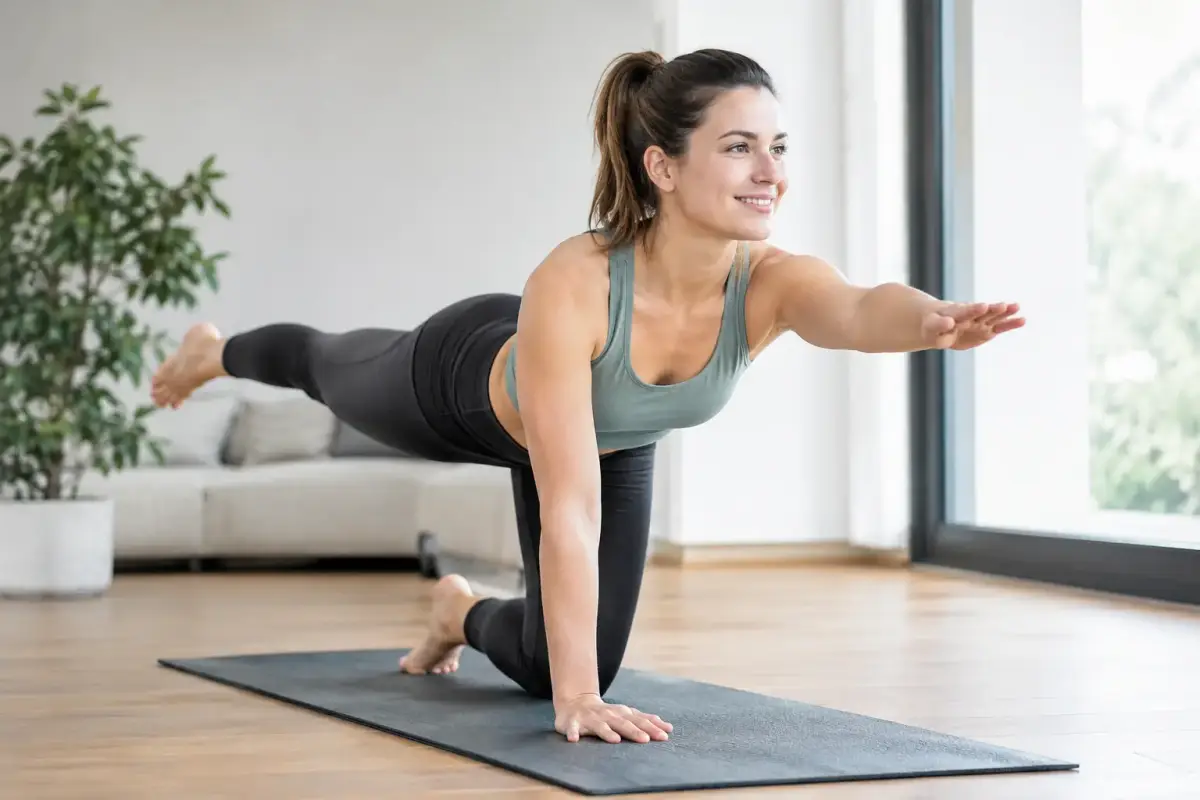
Opposite arm and leg reaches on all fours
Position yourself on your hands and knees, keeping your back and neck aligned. Slowly reach one arm forwards and the opposite leg backwards without rotating your pelvis. Hold briefly, keep breathing and change sides. This exercise combines trunk control with shoulder and hip stability.
A wall press during a short break
Stand a short distance from a wall and place both hands on it at shoulder height. As you breathe out, gently engage your trunk and press your hands against the wall for five seconds. Release as you breathe in. This is a simple way to reactivate your body after prolonged sitting, without changing into sportswear or exercising on the floor.
When additional support may be useful
Some people find it difficult to feel the relevant muscles despite practising exercises. Others have little time, want to rebuild strength gradually after childbirth, or are looking for a complement to sport and physiotherapy. Contact-free pelvic floor training on the WunderSessel may be an option for engaging the deeper muscles. It does not replace movement or medical assessment for persistent symptoms, but can complement structured training.
At our studio in Zurich, EMS PelviTraining on the WunderSessel focuses on this deep activation while you remain fully clothed and without direct physical contact. For people with busy schedules, this support may make regular sessions easier to maintain. Its suitability nevertheless depends on your starting point, symptoms and personal goals.
How to recognise progress
Better core stability rarely shows up first in the mirror. You may notice that getting up after sitting feels easier, that you carry shopping with more control or that you need fewer compensatory movements during sport. Greater comfort in your lower back and better body awareness are also useful signs.
Do not expect perfectly linear progress. Lack of sleep, stress, unfamiliar exertion and a busy working day can all affect how stable you feel. Focus on small, repeatable steps. Two minutes of conscious breathing, a walk and three sets of well-controlled exercises are worth more in the long term than a perfect plan you never follow.
Your body needs regular opportunities to move, not constant tension: move often, breathe freely and give your core the chance to show its strength in everyday activities.
Suitability is discussed individually before a session. Results may vary. WunderSessel training does not replace a medical diagnosis or prescribed treatment. Sessions are not provided during pregnancy. WunderSessel · Zurich